Finding the right activity table for a 12-month-old blends sensory exploration, fine motor practice, and safe, age-appropriate design. The products below offer music, lights, bead mazes, and身体-friendly wooden constructions to support early development. Each option accommodates floor play and standing play as your child grows, often with removable legs or adjustable height. This guide highlights five standout activity tables tailored to 12- to 18-month-olds, helping parents compare features, durability, and play value at a glance. A quick summary table is provided below.
| Product | Brand | Key Features | Age Range |
|---|---|---|---|
| HQXBNBY Baby Toys 6-12 Months Musical Learning Table | HQXBNBY | 5 keys, animal sounds, lights, 3-in-1 design | 6-12 months |
| Baby Einstein Curiosity Table Activity Play Station | Baby Einstein | Multiple STEAM activities, removable legs, group play | 12 months and up |
| KDSFT 8 in 1 Macaron Activity Table | KDSFT | Eight activities, bead maze, shape sorter, wooden build | 12+ months |
| Giant bean 11-in-1 Wooden Activity Table | Giant bean | 11 activities, Montessori-inspired, wooden craftsmanship | 12-36 months |
| Weilim Farm Montessori Activity Table | Weilim | Farm theme, bead maze, shape sorter, train track | 12+ months |
HQXBNBY Musical Learning Table
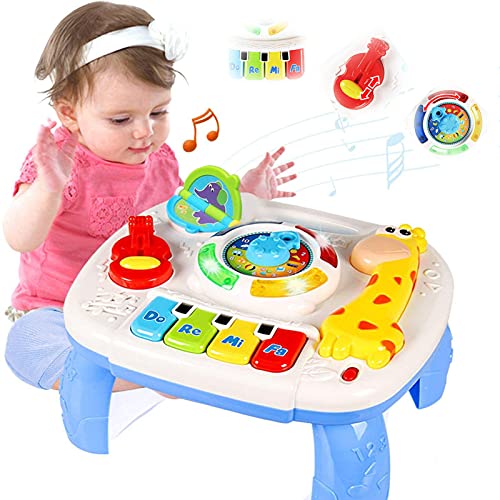
The HQXBNBY activity table targets early auditory and motor skills with animal sounds and a music-ready keypad. It features five keys representing do/re/mi/fa/so to support basic musical perception. The clock-based play area triggers different music as the pointer moves, while lights flash to reinforce cause-and-effect learning. A 3-in-1 design allows floor use, then standing play by attaching legs, and even crib-friendly portability when legs are removed. This versatility makes it suitable from sitting to standing stages of growth.
Designed for portability and space efficiency, this table supports solo play and shared play with caregivers who narrate animal sounds and rhythms. The built-in lights and sounds can captivate a young child’s attention, promoting auditory discrimination and anticipation skills. Its compact size is ideal for apartments or rooms with limited floor space, yet it provides a robust suite of sensory experiences that align with early education goals.
Baby Einstein Curiosity Table Activity Play Station

The Baby Einstein Curiosity Table emphasizes STEAM-inspired exploration with multiple activities designed to spark creativity and hands-on learning. The removable legs support varied modes of play—floor-based and standing—allowing parents to adapt as the child grows. The open-ended design enables several children to engage simultaneously, encouraging social interaction and cooperative play. The activity mix covers sensory, cognitive, and fine motor development through music, textures, and interactive elements.
Montessori-adjacent principles appear in the table’s emphasis on independent play and sequential discovery. Clear, bright visuals and modular play pieces help children practice problem-solving and early reasoning. With the growing capability to manipulate buttons, levers, and pages, toddlers gain confidence in self-directed exploration. The play station’s versatility makes it a practical long-term addition to early learning spaces.
KDSFT 8 in 1 Macaron Activity Table
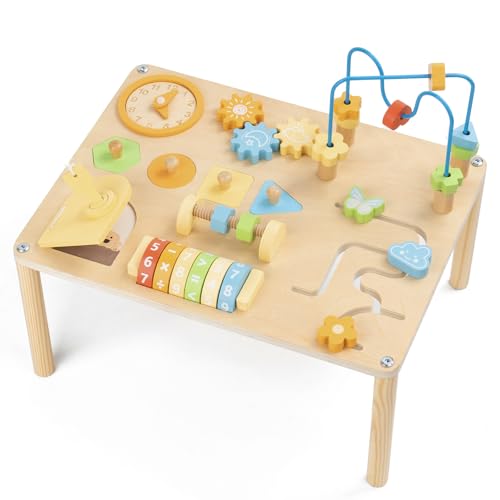
The KDSFT table offers eight integrated activities, including a bead maze, shape matching, and a clock with rotating gears. This multi-activity setup encourages prolonged engagement and varied motor challenges, supporting fine motor skills, hand-eye coordination, and early problem-solving. The wooden construction with rounded edges emphasizes safety and durability, while the macaron color palette fosters visual appeal for toddlers. Legs are adjustable to optimize height for different play styles and ages.
Educational content comes from the sequential tasks—matching shapes and numbers, tightening screws, or operating a door game—that push cognitive development. Parents can guide children through activities, turning play into mini lessons on cause-and-effect and spatial reasoning. The combination of tactile interactions and cognitive tasks makes this a well-rounded choice for 12 to 18-month-olds and beyond.
Giant bean 11-in-1 Wooden Activity Table

The Giant bean table delivers an expansive, Montessori-inspired play surface with 11 integrated activities. Its bead maze, shape sorter, fishing game, and bevy of other tasks promote fine motor control and cognitive flexibility. The wood construction with rounded edges adds durability and a warm feel to a child’s play space. The table’s multi-activity design reduces the need for multiple separate toys and supports long, varied play sessions that nurture problem-solving and hand-eye coordination.
Durability and safety are central, with high-quality wood and child-safe finishes. The size is suitable for floor play but also provides enough height for standing activities as children grow, allowing continued use from the 12-month to 3-year range. Parents appreciate the quiet, classic aesthetic that pairs well with various room decors.
Weilim Farm Montessori Activity Table

The Weilim activity table centers a farm-themed Montessori approach, integrating a bead maze, shape sorter, and a pull-along animal train track. This combination supports color and shape recognition, hand-eye coordination, and early logical thinking. The farm motif invites imaginative play and role-playing scenarios, which can help extend attention spans and narrative thinking during sessions with caregivers or siblings.
Designed for versatility, the Weilim table accommodates both sitting and standing play, making it adaptable for different rooms and child heights. The toy set emphasizes sensory engagement through movement and tactile exploration, aligning with early childhood education principles that prioritize hands-on, self-directed learning. It’s a solid long-term addition to a toddler’s play environment.
Buying Guide: Key Purchase Considerations And Comparisons
- Age appropriateness and growth forgiveness: Look for tables that transition from floor play to standing play, or have adjustable legs to grow with the child.
- Number and variety of activities: More activity options (bead mazes, shape sorters, music, gears) generally provide longer engagement and broader skill development.
- Material and safety: Favor sturdy, non-toxic wood or high-quality plastics with rounded edges and stable bases to minimize tipping risks.
- Portability and storage: Consider whether the table can be moved easily between rooms and whether components can be stored neatly when not in use.
- Sound and light considerations: Some parents prefer quieter tables; others value engaging lights and music for sensory exploration. Check volume controls when available.
- Assembly and maintenance: Review setup time, instructions clarity, and cleaning ease—especially for wooden surfaces and small parts.
- Space requirements: Measure your play area to ensure the table fits without crowding the room or blocking pathways.
- Durability and warranty: Look for solid wood or reinforced plastic constructions, and verify any warranty terms for peace of mind.